

 English
 Español
A historic dispute enters a decisive phase in 2026
After seven years of diplomatic tensions, relations between Spain and Mexico may finally be entering a new phase—one shaped as much by the future as by the past.
In March 2026, King Felipe VI made a rare and carefully worded acknowledgment of the “abuses” committed during the Spanish conquest of the Americas. The statement, while stopping short of a formal apology, has been widely interpreted as a gesture aimed at easing tensions with Mexico.
The timing is significant. Spain is preparing to host the Ibero-American Summit in Madrid on 4–5 November 2026, a major diplomatic event where Mexico’s presence will be crucial. In this context, the King’s remarks appear not only symbolic, but also strategic.
El presidente de México, Andrés Manuel López Obrador, ha enviado una carta al Rey de España, Felipe VI, en la que le insta a reconocer y pedir disculpas por los atropellos que las autoridades mexicanas consideran que España cometió en la conquista https://t.co/YY1RlBV6nX
— EL PAÍS (@el_pais) March 25, 2019
The origins of the Spain–Mexico diplomatic tensions
The current dispute dates back to March 2019, when former Mexican president Andrés Manuel López Obrador formally requested that Spain apologize for abuses committed during the conquest of Mexico in the 16th century.
Spain rejected the request, arguing that historical events should be understood within their own context rather than judged by modern standards. The response triggered a prolonged diplomatic rift that has since shaped relations between the two countries.
Over the years, tensions have manifested through:
- Diplomatic disagreements over historical memory
- Political rhetoric on both sides
- Symbolic gestures and public criticism
Despite this, economic and cultural ties have remained strong, highlighting the complex dual nature of the relationship.
A symbolic gesture with real diplomatic implications
The turning point came in March 2026, when King Felipe VI publicly acknowledged that the conquest of the Americas involved “abuses” and ethical controversies.
While Spain did not issue a formal apology, the shift in tone marked a significant departure from its previous position.
Mexico’s president Claudia Sheinbaum welcomed the statement, describing it as a “gesture of rapprochement” and signaling openness to improving bilateral relations.
Soon after, diplomatic signals from both countries suggested a gradual “thaw” after years of tension, raising cautious optimism among analysts and policymakers.
Por primera vez en la historia, un monarca español en ejercicio, reconoce que hubo "mucho abuso" durante la conquista de América o colonización. Así lo dijo hoy el Rey Felipe VI, durante su visita al Museo Arqueológico Nacional de Madrid, junto al embajador de México en España: pic.twitter.com/O437nc7pjV
— Vagabundo ilustrado (@vagoilustrado) March 16, 2026
Why the apology debate still matters
At the heart of the dispute lies a broader and unresolved question:
👉 Should modern states apologize for actions carried out centuries ago?
Mexico’s position has remained consistent:
- Acknowledgment of past abuses is a matter of historical justice
- Recognition is linked to respect for Indigenous communities
Spain, meanwhile, maintains that:
- Historical events must be interpreted within their own time period
- Present-day institutions cannot be held accountable for actions 500 years in the past
This fundamental disagreement has made the conflict unusually persistent, even as cooperation continues in other areas.
Political friction persists beneath the surface
Despite recent progress, tensions have not entirely disappeared.
Public statements from political figures in both countries continue to reflect diverging views on historical memory. In Mexico, the issue is framed as one of dignity and recognition, while in Spain it often sparks internal debate about national identity and historical interpretation.
President Claudia Sheinbaum has emphasized that the discussion is not about assigning blame, but about acknowledging historical realities. Meanwhile, voices within Spain continue to resist calls for a formal apology.
These dynamics suggest that while diplomacy is improving, underlying differences remain unresolved.
The Ibero-American Summit 2026: A diplomatic test for both nations
The recent easing of tensions cannot be understood without considering the upcoming Ibero-American Summit, scheduled for 4–5 November 2026 in Madrid.
Spain is eager to ensure full participation from all member countries, particularly Mexico, one of the most influential nations in the Ibero-American community. The success of the summit will depend heavily on high-level attendance and political cooperation.
In this context, King Felipe VI’s acknowledgment of historical abuses takes on added significance. Analysts widely interpret the gesture as part of a broader effort to rebuild trust and facilitate Mexico’s engagement in the summit.
After years of strained relations, the Madrid summit could become the first major international platform where both countries publicly demonstrate a renewed willingness to cooperate.
However, uncertainty remains. It is still unclear whether the current diplomatic thaw will be sufficient to guarantee a fully normalized relationship by the time leaders gather in Madrid.
A strategic relationship beyond political tensions
Despite the diplomatic dispute, Spain and Mexico continue to maintain a strong and mutually beneficial relationship.
- Spain remains one of the largest European investors in Mexico
- Both countries share deep cultural and linguistic ties
- Cooperation continues across trade, tourism, and international diplomacy
This coexistence of tension and cooperation reflects a broader reality: the relationship is too important for either side to allow political disagreements to fully disrupt it.
Why reconciliation matters now
The timing of the current diplomatic opening is not coincidental.
In an increasingly complex global environment marked by geopolitical uncertainty, both Spain and Mexico face growing pressure to strengthen alliances and cooperate on shared challenges.
The upcoming summit, combined with shifting global dynamics, has created an incentive for both countries to move beyond symbolic disputes and focus on practical collaboration.
For Spain, success will mean reinforcing its role as a bridge between Europe and Latin America. For Mexico, it represents an opportunity to assert its influence within the region while maintaining its position on historical issues.
Looking ahead: reconciliation or temporary détente?
While recent developments suggest progress, the future of Spain–Mexico relations remains uncertain.
Key questions persist:
- Will Spain eventually move toward a formal apology?
- Will Mexico consider symbolic gestures sufficient?
- Can both countries fully reset relations ahead of the Madrid summit?
The answers will determine whether the current moment becomes a lasting reconciliation or simply a temporary easing of tensions.
Conclusion: a fragile but meaningful turning point
The evolution of Spain–Mexico diplomatic tensions illustrates how deeply history can shape modern international relations.
King Felipe VI’s 2026 acknowledgment of colonial abuses has opened the door to renewed dialogue, but it has not resolved the core disagreement.
What is emerging instead is a careful recalibration—one driven not only by historical reflection, but also by present-day strategic needs.
👉 With the Ibero-American Summit in Madrid approaching, both countries now face a defining test: whether they can transform symbolic gestures into meaningful cooperation on the global stage.
Information Source:
https://www.latimes.com/world-nation
https://english.elpais.com/international/
Photo Attribution:
Photo credit:
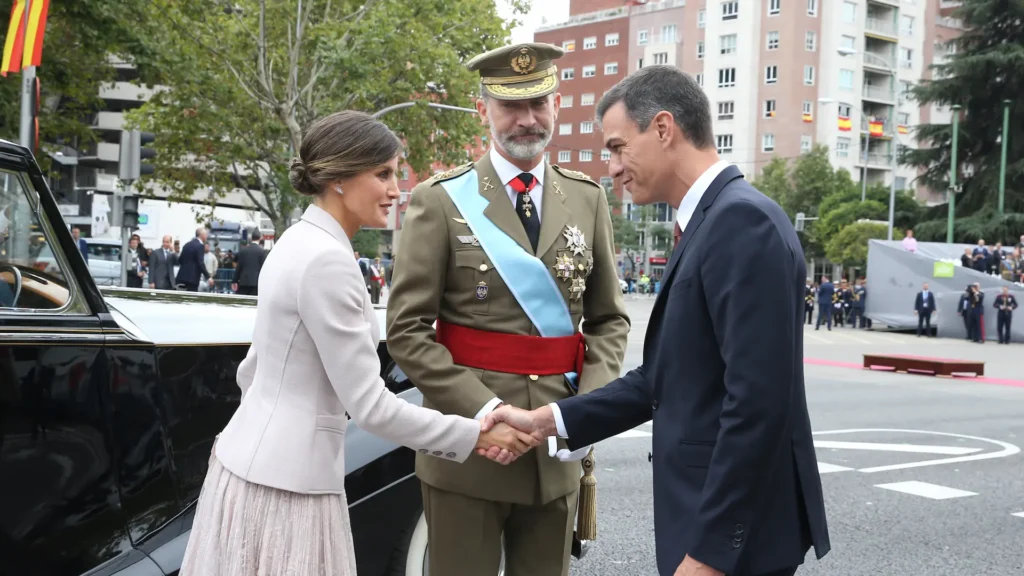
President Pedro Sánchez greets King Felipe VI and Queen Letizia of Spain at the National Day celebrations in Madrid (12 October 2018). © Ministry of the Presidency, Government of Spain / Fernando Calvo, licensed for reuse with attribution via Wikimedia Commons. https://w.wiki/J5PV
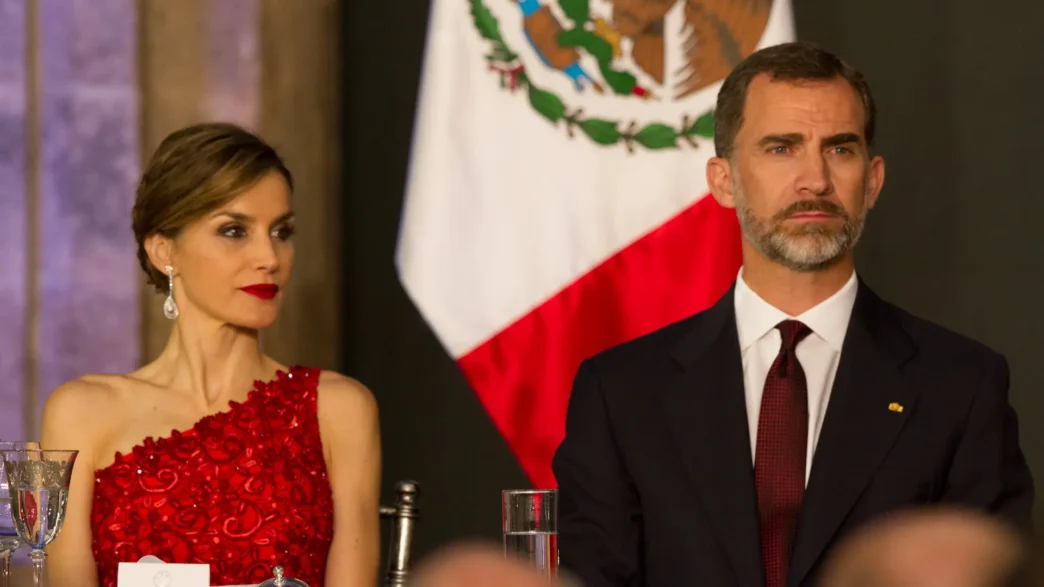
The King and the Queen of Spain (2015), by Presidencia de la República Mexicana, Creative Commons Attribution 2.0 Generic license. Wikimedia Commons https://w.wiki/KQyh