

 English
 Español
The British newspaper Financial Times has described Spanish Prime Minister Pedro Sánchez as “Donald Trump’s nemesis in Europe”, highlighting his unusually direct criticism of the U.S. president and Spain’s firm opposition to recent military strikes on Iran.
The analysis argues that Sánchez has openly said to Trump what other European leaders tend to avoid, setting him apart within the European Union at a time of heightened geopolitical tension.
The report appears amid escalating developments in the Iran conflict, renewed debate over NATO commitments, and growing scrutiny of transatlantic relations.
How Sánchez became Trump’s nemesis in Europe https://t.co/Zn3piHSyTX
— Financial Times (@FT) March 5, 2026
Why Is Pedro Sánchez Being Called Trump’s “Nemesis”?
According to the Financial Times, Sánchez has taken a more confrontational public tone toward Trump than most European leaders.
The newspaper notes that while many EU governments try to preserve diplomatic stability with Washington, Sánchez has chosen a clearer public stance, particularly regarding military escalation in the Middle East.
This approach has positioned Spain differently within broader U.S.–Europe relations.
Spain’s “No to War” Doctrine Returns
This week, Sánchez revived Spain’s long-standing “No to War” doctrine — a political message rooted in the country’s opposition to the 2003 Iraq War.
Speaking from La Moncloa, the prime minister questioned the objectives of the current military campaign related to Iran.
“Not even the objectives of this attack are clear,” Sánchez stated.
“From this war will not come a fair international order, higher wages, or a healthier environment.”
He emphasized that governments should prioritize improving citizens’ lives rather than escalating conflict.
The Financial Times described his remarks as a rare public rebuke from a European Union leader, contrasting them with other EU governments that often soften disagreements with U.S. administrations.
Spain’s Refusal to Cooperate Militarily on Iran Operations
A key element of the dispute concerns Spain’s decision to refuse the use of jointly operated military bases for offensive operations against Iran.
Spain hosts important U.S. facilities under long-standing bilateral agreements, including strategic installations relevant to NATO operations.
However, Madrid insists that any use of these bases must strictly comply with:
- Existing defense agreements
- International law
- United Nations principles
According to the Financial Times, Sánchez also referenced the Iraq War when criticizing the current strikes — a comparison that carries strong political symbolism in Spain.
This position has attracted attention in Washington, where President Trump has frequently criticized European allies over defense spending and burden-sharing within NATO.
Is Spain Taking a Strategic Risk?
Some analysts quoted by the Financial Times suggest Spain could face diplomatic consequences.
José Luis Manfredi, professor at the University of Castilla-La Mancha, argued that the United States would likely find alternative bases if necessary.
He questioned whether Spain gains strategic leverage from its strong public opposition.
Meanwhile, Amanda Sloat, professor at IE University and former U.S. adviser on European affairs, said Sánchez stands out as the most vocal European critic of Trump.
Her assessment underscores how unusual it is for a European leader to directly challenge a U.S. president on security policy in public statements.
Domestic Politics and International Image
The Financial Times also highlights the domestic dimension.
For Sánchez, a firm stance against Trump resonates with parts of Spain’s left-wing electorate and reinforces his image as a defender of:
- Multilateralism
- International law
- Diplomatic solutions
- European sovereignty
For Trump, clashes with European leaders can energize his political base, particularly around issues such as NATO spending and military commitments.
This dynamic adds a political layer to what might otherwise be a purely diplomatic disagreement.
Spain’s Position on the Iran Conflict
Spain’s government maintains that it will not participate in offensive military action and will not support escalation without clear legal authorization.
Sánchez stated:
“We will not be complicit in something that is bad for the world out of fear of reprisals.”
This statement reflects Spain’s broader foreign policy approach:
- Commitment to international law
• Preference for diplomacy over military escalation
• Opposition to unilateral action
• Support for multilateral frameworks
What Does This Mean for U.S.–Spain Relations?
Despite the strong rhetoric, there has been no formal diplomatic rupture between Madrid and Washington.
Spain remains:
- A NATO member
- A partner in transatlantic security structures
- A long-standing defense collaborator with the United States
However, the Financial Times characterization of Sánchez as Trump’s “nemesis” highlights visible political distance between the two leaders.
Whether this tension becomes structural or remains symbolic will depend on the evolution of the Iran crisis and broader transatlantic negotiations.
Conclusion: A Defining Moment in Spain’s Foreign Policy
The Financial Times’ description of Pedro Sánchez as Trump’s “nemesis in Europe” reflects more than personal politics.
It signals a wider debate about:
- Spain’s role in the Iran war
- The balance between NATO commitments and national sovereignty
- The limits of transatlantic alignment
- The future of European strategic autonomy
For now, Spain appears committed to its “No to War” doctrine, even as international pressures intensify.
The coming months will determine whether this stance becomes a defining feature of Spain’s foreign policy — or a temporary moment in an evolving geopolitical landscape.
Information Source:
Photo Attribution:
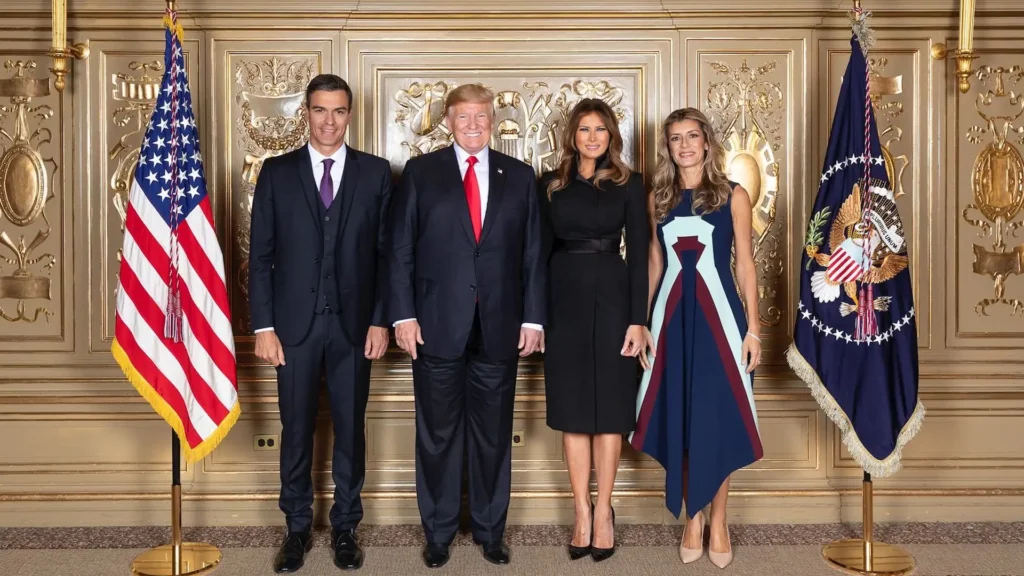
Photo credit: Official White House photo by Andrea Hanks, showing Presidents Donald J. Trump and Pedro Sánchez at the United Nations General Assembly, 25 September 2018. Public domain. Source: Wikimedia Commons (file President_Donald_Trump_and_Pedro_Sánchez.jpg). https://w.wiki/J9zG
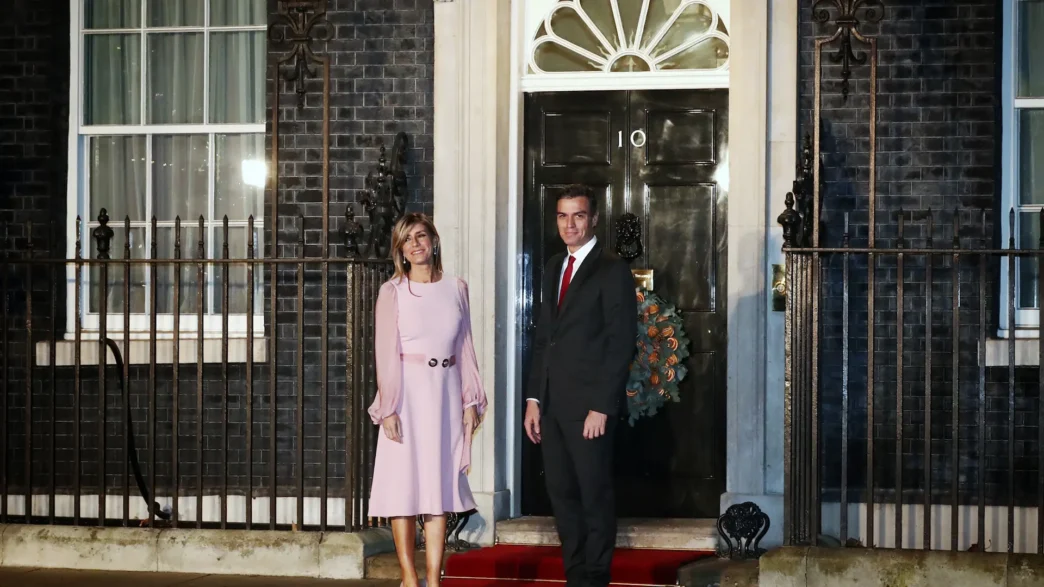
Photo: Pedro Sánchez and Begoña Gómez at Number 10 for NATO leaders meeting (3 Dec 2019) by Ministry of the Presidency, Government of Spain / La Moncloa. Licensed under the Government of Spain’s legal notice (free use with attribution and date, no distortion).
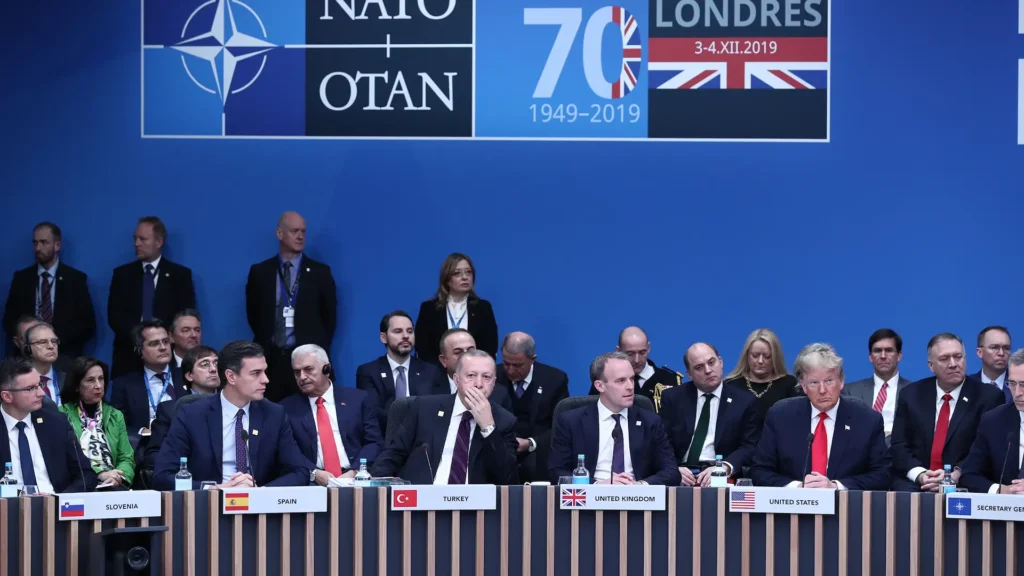
Image: Spanish Prime Minister Pedro Sánchez attending the 2019 NATO summit in London, United Kingdom, on 4 December 2019. Photo by Pool Moncloa/Fernando Calvo, published by the Ministry of the Presidency of the Government of Spain. Used under an attribution-only license; redistribution and reuse permitted with proper credit. Source: Wikimedia Commons / Ministry of the Presidency, Government of Spain. https://w.wiki/JBWu
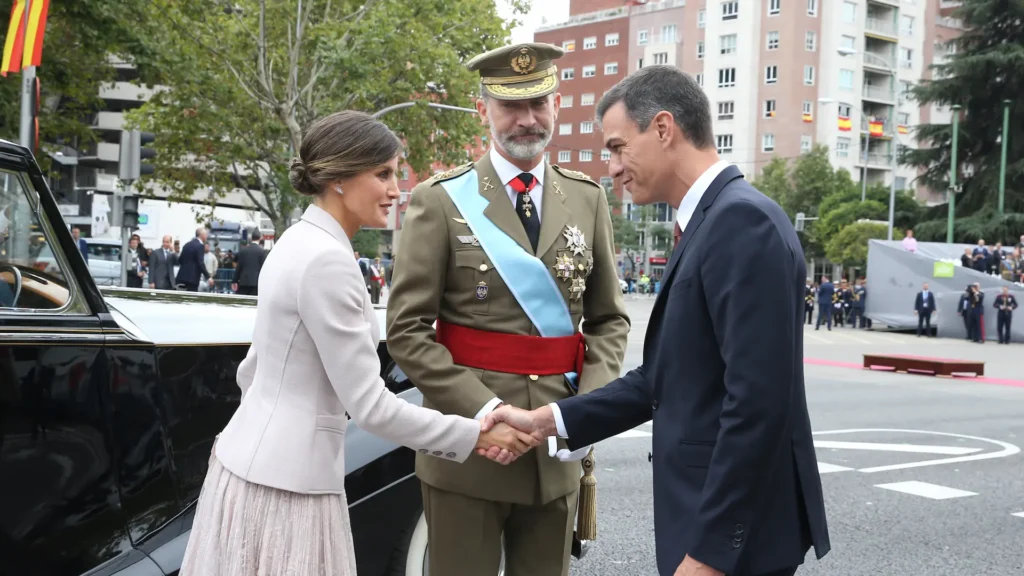
Photo credit: President Pedro Sánchez greets King Felipe VI and Queen Letizia of Spain at the National Day celebrations in Madrid (12 October 2018). © Ministry of the Presidency, Government of Spain / Fernando Calvo, licensed for reuse with attribution via Wikimedia Commons. https://w.wiki/J5PV
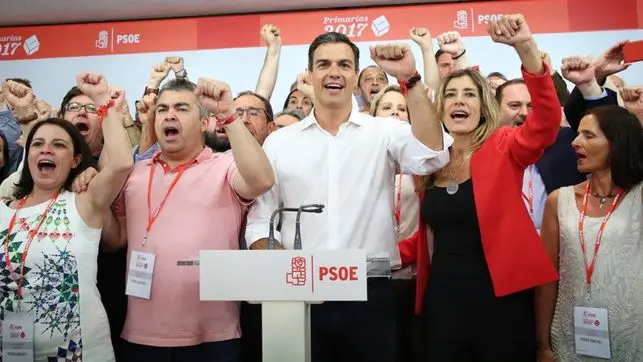
Photo: Pedro Sánchez after winning the PSOE primaries, singing “La Internacional” (21 May 2017). By Marta Jara / eldiario.es. Licensed under CC BY-SA 3.0 Spain.