

 English
 Español
AI is set to reshape Spain’s labour market and productivity
Nearly 60% of jobs in Spain could be technically automated using today’s artificial intelligence and robotics technologies, according to a new report from the McKinsey Global Institute, part of McKinsey & Company.
The findings position Spain’s labour market at the centre of one of the most significant economic transformations in decades, driven by AI automation, generative AI systems, and advanced robotics.
The study, Agents, Robots and Us: How AI Reshapes Work and Skills in Europe, analyses how existing technologies are already capable of transforming work across ten European economies, including Spain.
It concludes that Spain could generate around 167 billion dollars (€142 billion) in additional economic value by 2030 if it successfully accelerates AI adoption and restructures how work is performed.
However, McKinsey warns that these gains depend heavily on policy decisions, workforce adaptation, and business transformation strategies.


What jobs can AI actually automate in Spain?
The report breaks down automation potential into two major categories:
🤖 AI agents (44% of work hours)
A large share of tasks could be handled by AI agents, including:
- Data analysis
- Communication tasks
- Decision support systems
- Workflow coordination
These systems are increasingly powered by generative AI tools capable of handling complex cognitive work.
🦾 Robotics (15% of work hours)
Physical automation could cover:
- Industrial production
- Logistics and warehousing
- Repetitive manual operations
Together, this represents nearly 60% of total work hours in Spain.
Importantly, the report stresses that this does not mean job losses of the same scale, but rather a redesign of tasks and workflows.
€142 billion AI opportunity for Spain’s economy
If AI adoption accelerates, Spain could unlock up to 167 billion dollars (€142 billion) in economic value by 2030.
This would come from higher productivity, reduced inefficiencies, and AI-driven process redesign across key sectors.
📊 Key sectors benefiting most:
- Retail and commerce
- Manufacturing and industry
- Public administration
These industries are particularly exposed because they rely heavily on repeatable processes and structured decision-making.
In practical terms, AI could deliver:
- Faster public services
- Smarter supply chains
- More efficient business operations
- Improved data-driven governance
However, McKinsey warns that slow adoption could sharply reduce the economic upside, widening the gap between Europe, the United States, and China.


AI skills demand is rising sharply in Spain
One of the clearest signals of transformation is the rise in AI skills demand.
Since 2023, demand for workers with AI fluency in Spain has increased by 4.4 times.
🧠 What “AI fluency” means:
It refers to the ability to:
- Use AI tools effectively
- Supervise AI systems
- Integrate AI into daily workflows
This is no longer limited to engineers. It now includes:
- Managers
- Finance professionals
- Operations teams
- Customer service roles
📌 Most in-demand job areas:
- Information technology and mathematics
- Management roles
- Business, finance, and operations
This signals a shift toward AI-assisted workplaces, where humans and machines collaborate continuously.


AI will augment jobs, not fully replace them
Despite high automation potential, McKinsey emphasises that AI is not expected to replace most workers.
The report estimates that:
- 85% of current human skills will still be needed
- Around 75% of job skills will be used in hybrid human-AI environments
🧩 Key human strengths that remain essential:
- Ethical judgement
- Strategic thinking
- Emotional intelligence
- Complex problem-solving
These capabilities remain difficult for AI systems to replicate reliably.
Instead of replacing workers, AI is expected to:
- Remove repetitive tasks
- Increase productivity
- Shift roles toward supervision and decision-making
Europe’s broader AI transformation
Across the European Union, AI could generate up to 1.9 trillion dollars in economic value by 2030 under an optimistic scenario.
💡 Value distribution:
- 82% from AI software agents
- 18% from robotics
This reflects the growing dominance of digital automation over physical automation.
The analysis covers:
- 1,800 job roles
- 10,500 skills
It also shows that even white-collar professions such as:
- Finance
- Consulting
- Management
are increasingly exposed to automation pressure.
Europe faces demographic pressure to adopt AI
A key driver behind AI adoption is Europe’s ageing population.
As the workforce shrinks, AI is expected to:
- Support productivity growth
- Offset labour shortages
- Stabilise GDP output
However, McKinsey highlights a major issue:
Around 90% of companies are experimenting with AI, but only a fraction are achieving meaningful productivity gains.
The main barrier is not technology, but organisational transformation.
The reskilling challenge will define success
By 2030, work structures are expected to change significantly:
- Less time spent on execution
- More focus on supervision and analysis
- Growth in strategic and creative roles
This shift requires massive investment in reskilling programs.
🎓 Workers will need to learn:
- How to collaborate with AI systems
- How to interpret AI-generated outputs
- How to apply human judgement in AI-driven workflows
Without large-scale reskilling, much of the productivity potential could remain unrealised.
A turning point for Spain’s economy
For Spain, the rise of AI represents both a major opportunity and a structural challenge.
If adopted effectively, AI could:
- Increase national productivity
- Strengthen key industries
- Improve public sector efficiency
But success depends on more than technology alone.
It requires:
- Workforce adaptation
- Organisational redesign
- Continuous learning systems
- Human-AI collaboration models
As McKinsey concludes, the future of work will not be defined by replacement, but by integration — where economic value emerges from combining human judgement with machine intelligence.
Information Sources:
Photo Attribution:
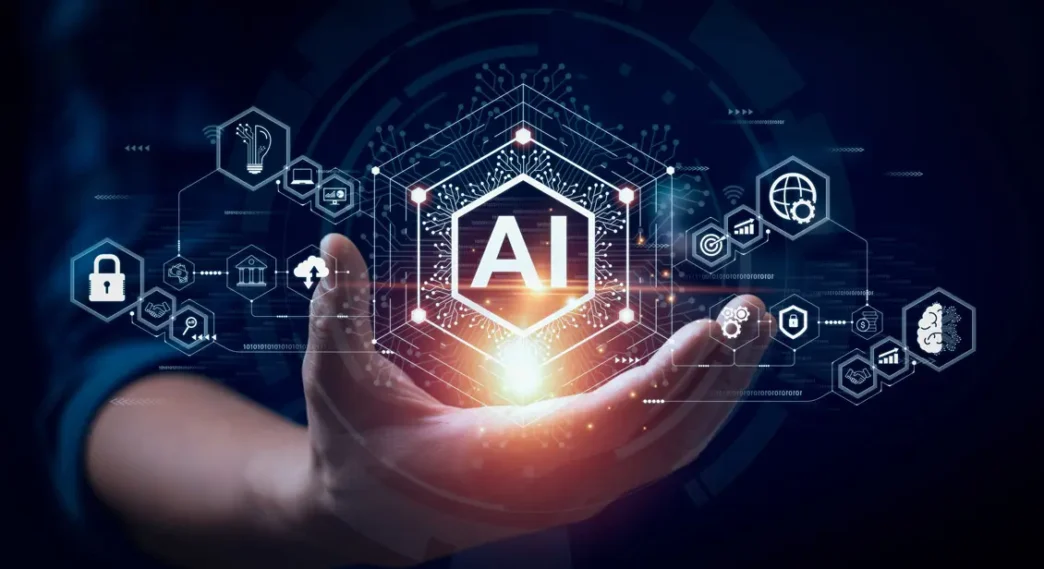
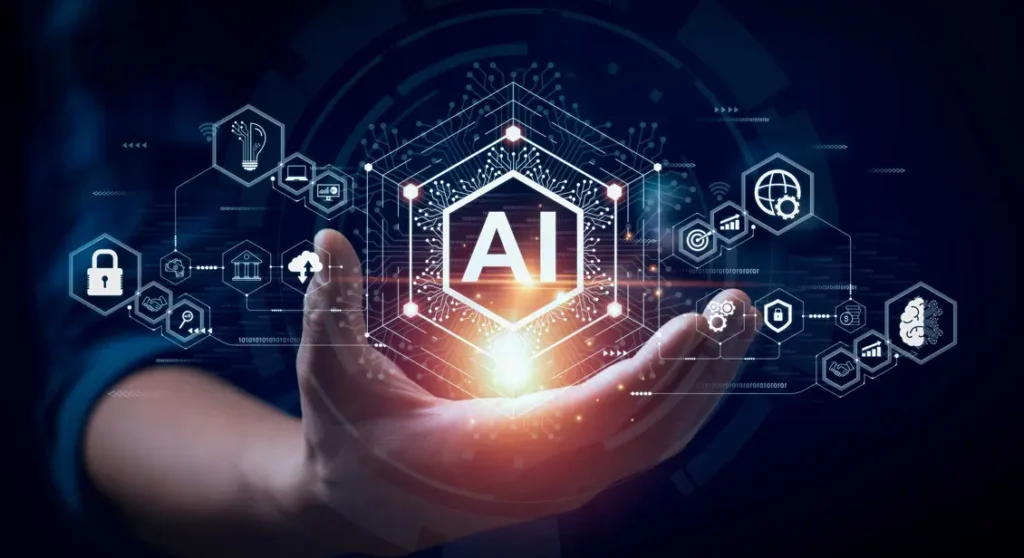
Image credit: Artificial Intelligence, by Anaf Ibn Shahibul 2 / Creative Commons Attribution 4.0 International license (via Wikimedia Commons) Source: https://w.wiki/Hbdg