


 English
 Español
Spain has ordered internet providers to block access to Polymarket and Kalshi, escalating its crackdown on what authorities describe as unlicensed online gambling platforms operating inside the country.
The Spanish government announced that both prediction market platforms are under investigation for allegedly offering gambling services without the mandatory licenses required under Spanish law. The move marks one of Europe’s most significant regulatory actions against the rapidly expanding prediction market industry.
Spain’s Ministry of Social Rights, Consumer Affairs and Agenda 2030 confirmed that sanction proceedings have been opened against both companies. The decision was officially published Tuesday in the country’s state bulletin, the Official State Gazette (BOE).
As part of the precautionary measures imposed by the Directorate General for the Regulation of Gambling (DGOJ), Spanish telecommunications providers have been instructed to restrict access to both platforms while the investigation continues.
Authorities estimate the administrative process could take between three and four months.
Importantly, the measure is temporary and does not yet represent a final ruling against either company. However, it effectively suspends the operation of Polymarket and Kalshi in Spain pending the outcome of the investigation.

Why Spain Is Blocking Polymarket and Kalshi
The core issue centers on how Spanish regulators classify prediction markets.
Platforms such as Polymarket and Kalshi allow users to buy and sell positions tied to the outcome of future events. Prices fluctuate depending on how likely traders believe an event is to happen, turning public predictions into tradable assets.
Users can place money on a wide range of outcomes, including:
- Elections
- Economic indicators
- International conflicts
- Sports tournaments
- Political decisions
Some prediction markets have even allowed bets on speculative topics such as extraterrestrial disclosure or ceasefire announcements involving the United States and Iran.
Spanish authorities argue that this model closely resembles a betting exchange, where users wager money against one another while the platform collects commissions from transactions.
According to the DGOJ, that activity qualifies as online gambling under Spanish law and therefore requires a specific administrative license.
The government also stressed that operators without licenses are not subject to the strict technical and consumer protection requirements imposed on regulated gambling companies.
Concerns Over Identity Verification and Consumer Protection
Spanish regulators say the investigation goes beyond licensing issues.
Authorities claim Polymarket and Kalshi may lack mandatory safeguards designed to protect users, particularly vulnerable individuals and minors.
Licensed gambling operators in Spain are required to implement:
- Identity verification systems
- Age restrictions
- Controls preventing minors from gambling
- Self-exclusion systems for problem gamblers
- Regulatory oversight protections
According to the ministry, unauthorized operators “lack the technical and regulatory guarantees required in Spain.”
The Spanish government has tightened its stance on online gambling regulation in recent years, particularly in areas involving addiction prevention, advertising restrictions, and consumer protections.
The rapid growth of prediction markets has created new challenges for regulators worldwide because these platforms often operate in a legal gray area between finance, forecasting, and gambling.
Supporters argue that prediction markets provide valuable public forecasting tools by aggregating information from large numbers of users. Critics, however, say they function more like speculative betting markets with limited safeguards.
Why Prediction Markets Are Facing Global Scrutiny
The crackdown comes as prediction markets continue to grow into a multi-billion-dollar industry.
Once considered a niche internet trend, platforms like Polymarket gained mainstream attention during the 2024 United States election cycle, when millions of dollars flowed into contracts tied to election outcomes and political developments.
The industry’s rapid expansion has triggered increasing concern among regulators about:
- Market manipulation
- Insider information
- Addiction risks
- Ethical concerns surrounding political and war-related betting
Critics warn that prediction markets may incentivize users with privileged information to profit from sensitive global events.
In recent months, Polymarket has hosted markets tied to international conflicts, diplomatic negotiations, and political leadership changes, often generating massive trading activity shortly after breaking news events.
Spain’s decision reflects broader European caution toward the sector.
Authorities argue that when users risk real money on uncertain future events, the activity should be regulated as gambling regardless of whether platforms describe themselves as financial exchanges or forecasting tools.
How Prediction Markets Differ From Traditional Sports Betting
Prediction markets operate differently from traditional sportsbooks because users trade directly with one another rather than betting against a bookmaker.
The value of positions changes dynamically according to market sentiment. For example, if traders believe a political outcome has become more likely, the associated contract price rises accordingly.
Supporters claim this system can sometimes produce more accurate forecasts than traditional polls because it combines financial incentives with collective public information.
Economists and academic researchers have studied prediction markets for years as potential tools for measuring public expectations and forecasting future events.
However, regulators increasingly focus on the commercial reality of these platforms rather than their theoretical forecasting value.
Spain’s government argues that because companies such as Polymarket and Kalshi facilitate transactions while collecting fees, they fall within the scope of regulated online gambling activity.

Spain’s Decision Could Influence Europe
Spain is not alone in increasing oversight of prediction market platforms.
Several European countries are examining whether companies operating internationally comply with local gambling and financial regulations. Regulators also face growing challenges linked to the cross-border nature of digital services.
The investigation into Polymarket and Kalshi could become an important test case for how Europe regulates the next generation of online wagering platforms.
For now, the temporary block is expected to remain in place until Spanish authorities issue a final decision later this year.
If regulators ultimately conclude that the companies violated gambling laws, Polymarket and Kalshi could face sanctions and long-term restrictions on operating in Spain.
The case highlights the growing global debate over where prediction markets end and online gambling begins.
FAQ Spain Blocks Polymarket and Kalshi
Why did Spain block Polymarket and Kalshi?
Spain blocked the platforms because regulators believe they may be operating as unlicensed online gambling services.
Are prediction markets legal in Spain?
Prediction markets may require a gambling license in Spain if users wager money on uncertain future events.
What is Polymarket?
Polymarket is a prediction market platform where users trade positions on the outcome of future events.
What is Kalshi?
Kalshi is a regulated US-based prediction market platform that allows users to trade event-based contracts.
How long will the block remain in place?
Spanish authorities estimate the investigation could take between three and four months.
Information Source:
https://cadenaser.com/nacional/
https://www.elcomercio.es/economia/
Photo Attribution:
Photo: Pedro Sánchez at the NATO Summit (June 29, 2022)
Source: La Moncloa (Government of Spain)
Author: Pool Moncloa / Fernando Calvo Rollán
License: Government of Spain – free use with attribution https://w.wiki/KZVv
Plaza de Colón, by Enrique Dans, Creative Commons Attribution 2.0 Generic, Wikimedia Commons: https://w.wiki/JGMs
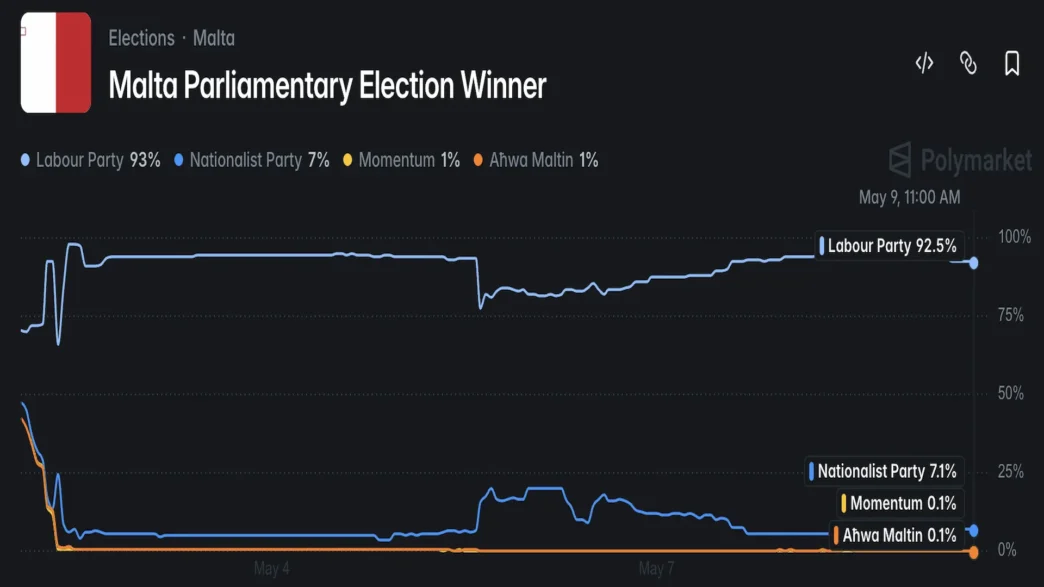
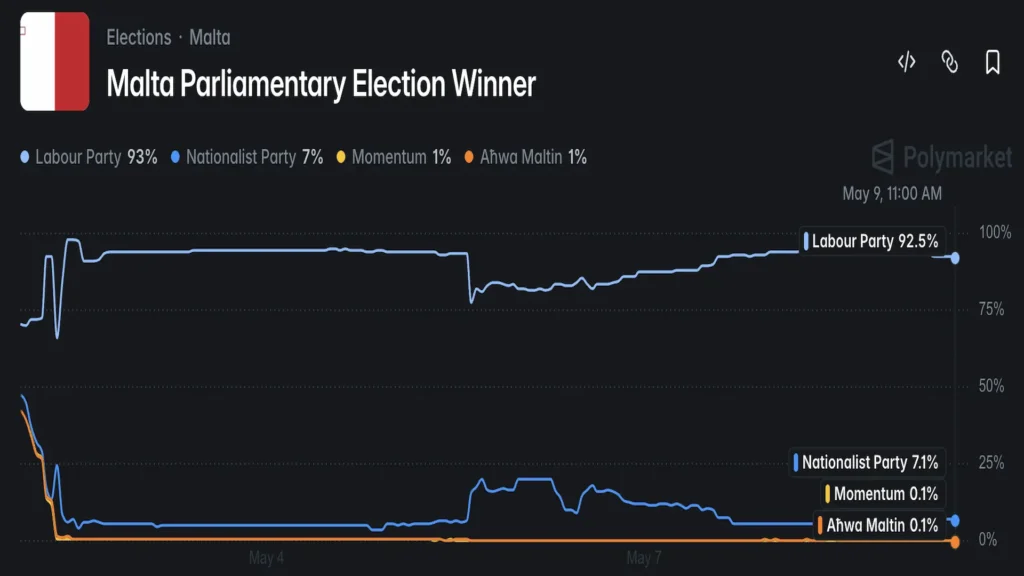
Screenshot of the Malta Parliamentary Election Winner page on Polymarket, by Hallija, Creative Commons Attribution-Share Alike 4.0 International license. Wikimedia Commons: https://w.wiki/PP6J