Could Spain’s Socialists Still Pull Off an Election Comeback?

Even if you don’t like Pedro Sánchez, are you sure you understand everything that could happen in this election?
Presidents @sanchezcastejon and @realDonaldTrump met again today at a reception for Heads of State at the #UNGA, hosted by President Trump (Official @WhiteHouse Photo by Andrea Hanks) Presidents @sanchezcastejon and @realDonaldTrump met again today at a reception for Heads of State at the #UNGA, hosted by President Trump (Official @WhiteHouse Photo by Andrea Hanks)

The overlooked factors that could turn Spain’s election upside down.

Even if you don’t like Pedro Sánchez, are you sure you understand everything that could happen in this election?


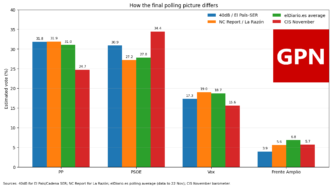
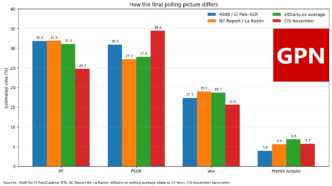
Most national polls suggest that Spain’s People’s Party (PP) is ahead of the Socialists (PSOE), with the far-right Vox in a potentially decisive position. The latest CIS estimate puts the PSOE at 34.4%, against 24.7% for the PP and 15.6% for Vox. On the surface, the picture looks fairly clear.

Could voters who are not particularly enthusiastic about Sánchez end up voting to prevent a government that includes Vox?

But elections are not decided by national averages alone. And this one could be shaped by factors that are easy to overlook — from women’s votes and international politics to the complicated mathematics of Spain’s electoral system.

There is also a bigger question hanging over the result: could voters who are not particularly enthusiastic about Sánchez end up voting to prevent a government that includes Vox?

That possibility deserves a closer look.

1. This is about more than another change of government

For international observers, one of the most important aspects of this election is the prospect of Vox entering Spain’s national government.

Vox is not simply another conservative party. It is a far-right political force whose positions on immigration, gender equality, historical memory and national identity have placed it firmly within Europe’s wider radical-right movement.

That distinction matters particularly in Spain.

The prospect of the far right entering the national executive carries a historical weight that cannot be understood simply by looking at the latest opinion polls.

The country experienced a devastating Civil War after a military uprising against the democratically elected Republic in 1936, followed by almost four decades of Francoist dictatorship. Spain’s transition to democracy eventually brought political forces together around a new constitutional settlement.

The prospect of the far right entering the national executive therefore carries a historical weight that cannot be understood simply by looking at the latest opinion polls.

This does not mean that contemporary Spain is returning to the 1930s, nor that Vox and Francoism are interchangeable. But it does mean that the possibility of a PP-Vox government has a significance that goes beyond ordinary political competition.

And that could influence how some people vote.

Elections are not decided only by what voters want to bring into power. Sometimes they are decided by what they are determined to keep out.

2. Could the international climate be helping Sánchez?

Pedro Sánchez has made international politics a prominent part of his political identity. His confrontations with Donald Trump, his criticism of the Israeli government’s conduct in Gaza and his defence of a more independent European position have given him visibility well beyond Spain.

The rejection was not confined to the left. A majority of PP voters also expressed a negative opinion of Trump.

But could that visibility translate into votes?

There are some interesting figures.

A 2025 survey by the Franklin Institute and the University of Alcalá found that 67% of Spaniards had a negative opinion of Trump’s presidency. Around 78% considered his trade policy misguided, while 69% disapproved of his position on Israel and Palestine.

Perhaps more revealingly, the rejection was not confined to the left. A majority of PP voters also expressed a negative opinion of Trump.

A separate CIS survey in 2026 found that 76.5% of Spaniards disapproved of the US president. Even among PP voters, disapproval stood at around 57%.

There is a familiar sporting analogy: even a Real Madrid supporter can cheer when a Barcelona player scores for Spain.
Elon Musk y el presidente de Argentina, Javier Milei, hablando en la Conferencia de Acción Política Conservadora (CPAC) de 2025 en el Gaylord National Resort & Convention Center en National Harbor, Maryland.

Consider some recent examples:

  • Argentina’s Javier Milei travelled to Madrid for a Vox event in 2024, where he made insulting remarks about Sánchez’s wife, triggering a serious diplomatic crisis between Spain and Argentina.
  • Vox leader Santiago Abascal publicly defended Jair Bolsonaro after the former Brazilian president was sentenced to 27 years in prison for his role in an attempted coup.
  • Abascal has met Benjamin Netanyahu in Jerusalem and openly praised his position.
  • Vox has repeatedly expressed political affinity with Donald Trump, while Feijóo has advocated a more accommodating approach to relations with Washington.

During Vox’s campaign launch in November 2026, several international political allies, including Milei and representatives of the Bolsonaro political family, sent messages of support to Abascal.

That creates an interesting political opportunity for Sánchez. His criticism of Trump may resonate with a broader section of the electorate than the traditional Socialist vote.

Gaza presents a more complicated picture. Public opinion in Spain has been strongly critical of the Israeli government’s conduct, but opinion on the Spanish government’s own response has been much more divided. Disapproval of Netanyahu does not automatically translate into support for Sánchez.

Still, the international dimension should not be dismissed. Some voters may dislike the Socialist government on domestic issues but feel that Sánchez has defended Spain’s position on the world stage.

There is a familiar sporting analogy: even a Real Madrid supporter can cheer when a Barcelona player scores for Spain.

Could some voters make a similar calculation at the ballot box?

It is unlikely to decide the election on its own. But it could help explain why Sánchez’s international profile is not necessarily the electoral liability that some of his opponents might expect.

3. The women's vote could be one of the decisive factors

Women outnumber men by approximately 1.2 million in Spain’s electoral census. They are also more likely to be undecided, according to recent polling reported by El País.

The figures are worth examining. Around 7.8% of women surveyed were undecided, compared with 5.8% of men. The estimated Socialist vote among women was also 3.6 percentage points higher than among men.

Vox's positions on abortion, gender equality and policies addressing violence against women could become particularly relevant here

That does not guarantee a late swing towards the PSOE. But it does mean that a significant part of the electorate has yet to make up its mind — and that the final campaign could matter.

Vox’s positions on abortion, gender equality and policies addressing violence against women could become particularly relevant here. For some voters, the prospect of a government dependent on Vox may be a powerful reason to reconsider their choice.

And there is another important point: women do not need to be committed Socialist voters to influence the result. Some may simply decide that the alternative is unacceptable.

The question is not just how women intend to vote today. It is how many of those still undecided will actually turn out — and what finally persuades them.

4. Forty seats could be decided by the way people vote, not just by how many

Here is where Spain’s electoral system becomes particularly important.

Unlike a straightforward national proportional system, Spain allocates parliamentary seats through provincial constituencies. That means the geographical distribution of votes can matter as much as the national percentage.

An analysis published on 21 November identified 40 seats where tactical voting could be particularly important.

A party can win a substantial number of votes across the country and still fail to translate many of them into seats, particularly where support is spread thinly across smaller constituencies.

This is where tactical voting enters the picture.

An analysis published by El País on 21 November, based on 20,000 simulations and the latest polling data, identified 40 seats where tactical voting could be particularly important. Its wider model identified 83 seats as being in play.

The findings are striking. On the left, the PSOE appears to be the most effective option for winning seats in 35 of Spain’s 52 provinces. In 19 of those provinces, it is the only party on the left whose support translates into additional seats in the model’s simulations.

In other words, voters who might otherwise support smaller left-wing parties could decide to back the Socialists if they believe that is the most effective way to prevent a right-wing victory.

But the same logic applies to the right. In some provinces, voting for the PP is more effective; in others, Vox has the advantage. Competition between the two parties can also cost the right seats.

The result may depend not simply on how many people vote for each bloc, but on how intelligently those votes are distributed.

That is one reason why a national polling lead does not necessarily translate into a comfortable parliamentary majority.

5. The PP may have a problem beyond the Socialist vote

The PP’s challenge is not only to attract voters from the left. It must also convince moderate and centrist voters that a vote for the party will not ultimately mean a government dependent on Vox.

For some conservative voters, that may be an acceptable price for removing Sánchez. For others, it may be a step too far.

Voters who would otherwise support the PP may have to consider what that actually means.

The PP has spent much of the campaign trying to present itself as the alternative government. But if its route to power depends on Vox, voters who would otherwise support the PP may have to consider what that actually means.

Some could abstain. Others might choose a different party. A smaller number could even vote tactically for the PSOE if they regard preventing a PP-Vox government as more important than their usual political preferences.

We should not assume that all moderate PP voters will make this choice. But even a relatively small movement could matter in a close contest.

And this brings us back to the central question: how many people are voting for the government they want, and how many are voting against the government they fear?

6. The defensive vote: a coalition that may not appear in the polls

There is a final factor that could connect many of these arguments.

Not every vote for the PSOE would necessarily represent renewed enthusiasm for Sánchez or his government. Some voters may be dissatisfied with the cost of living, housing, public services or the political climate. They may have little affection for the Socialists.

But when faced with the possibility of a PP government reliant on Vox, they could still decide that the alternative is worse.

People who do not necessarily support a party's programme, but who vote to prevent an outcome they consider unacceptable.

This is what might be called a defensive vote: people who do not necessarily support a party’s programme, but who vote to prevent an outcome they consider unacceptable.

It could involve pensioners concerned about social protections, younger voters worried about housing and their future, women concerned about equality, or moderate conservatives uncomfortable with the far right.

These groups do not share the same political priorities. They may not even agree on much. But they could arrive at the same decision for very different reasons.

That kind of coalition is difficult to measure. It may not appear as a clear movement in national polling, and it does not necessarily produce enthusiastic campaign crowds.

Yet it can be decisive.

So, is a Socialist comeback really possible?

None of these factors guarantees a PSOE victory. Sánchez faces serious political headwinds, and the polls may ultimately prove right. A national lead for the right should not be dismissed simply because there are alternative scenarios.

But the election is more complicated than a comparison of national vote percentages suggests.

The prospect of Vox entering government may motivate voters who would otherwise have little reason to support the Socialists.

The international climate may be more favourable to Sánchez than some expect. Women remain a significant source of uncertainty. Tactical voting could reshape the distribution of seats across provincial constituencies. And the prospect of Vox entering government may motivate voters who would otherwise have little reason to support the Socialists.

None of this requires voters to suddenly fall in love with Pedro Sánchez.

It only requires enough of them to decide that the alternative is worse.

And that may be the most important factor of all.

Because this election is not just a referendum on Sánchez’s record. It is also a decision about what kind of government Spain is prepared to accept — and how far voters are willing to go to prevent one they fear.

The polls may be telling us who is ahead today.

They may not yet be telling us who will be willing to stop them on election day.

Photo Attribution:

Photo credit: Elon Musk and President of Argentina Javier Milei speaking at the 2025 Conservative Political Action Conference (CPAC) at the Gaylord National Resort & Convention Center in National Harbor, Maryland, by Gage Skidmore, used under Creative Commons Attribution-ShareAlike 2.0 Generic (CC BY-SA 2.0). License: https://creativecommons.org/licenses/by-sa/2.0/. Source: Wikimedia Commons: https://w.wiki/Hj5V

Photo credit: Official White House photo by Andrea Hanks, showing Presidents Donald J. Trump and Pedro Sánchez at the United Nations General Assembly, 25 September 2018. Public domain. Source: Wikimedia Commons https://w.wiki/J9zG