

 English
 Español

The last surveys before Spain’s election blackout show the PP leading most private estimates, while the PSOE gains ground. The CIS remains a striking outlier, but the parliamentary arithmetic points in a similar direction across the other models.
With Spain’s general election approaching on 29 November, the final wave of polling published before the legal blackout offers a revealing picture of the campaign. The main finding is relatively consistent: the right-wing bloc remains on course for a parliamentary majority, while the contest between the People’s Party (PP) and the Spanish Socialist Workers’ Party (PSOE) has become considerably closer in some surveys.
Yet the polls do not tell exactly the same story. The latest estimates from 40dB, NC Report and elDiario.es all put the PP ahead, but differ over the size of its lead. The November barometer from Spain’s public Centre for Sociological Research (CIS), meanwhile, gives the PSOE a substantial advantage.
The result is a divided polling picture: a close contest for first place in some private surveys, a much clearer Socialist lead in the CIS figures, and a relatively consistent advantage for the right when projected parliamentary seats are considered.


The final polling snapshot
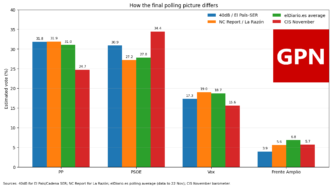
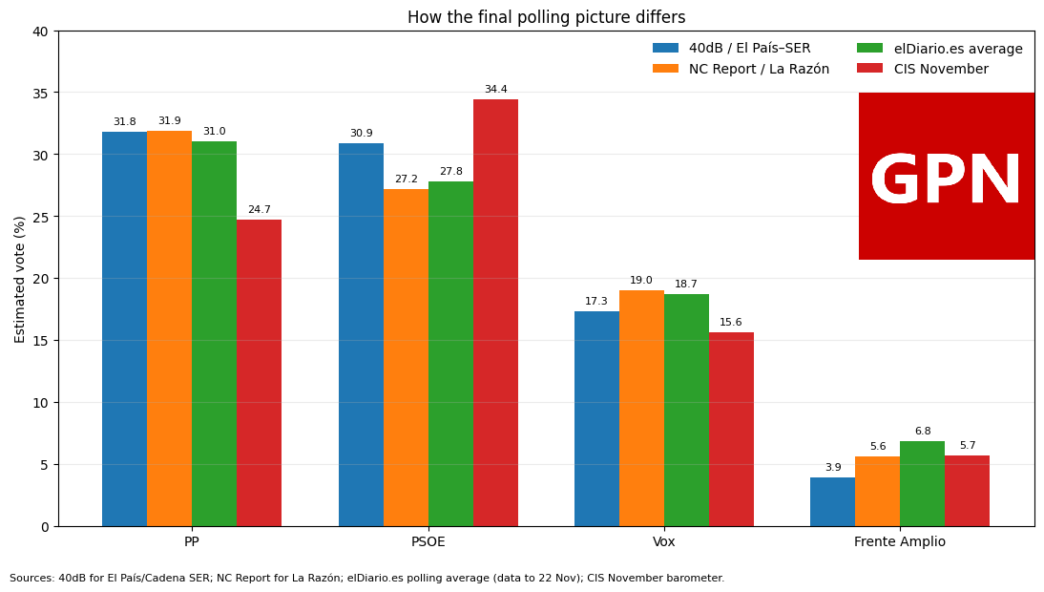
The latest figures from the three non-CIS sources place the PP between 31% and 31.9% of the estimated vote. The PSOE ranges from 27.2% to 30.9%, while Vox stands between 17.3% and 19%.
The differences become particularly clear when the estimated vote for the two largest parties is compared.
Poll or estimate | PP | PSOE | Vox | F.Amplio |
40dB / El País–Cadena SER | 31.8% | 30.9% | 17.3% | 3.9% |
NC Report / La Razón | 31.9% | 27.2% | 19.0% | 5.6% |
elDiario.es polling average | 31.0% | 27.8% | 18.7% | 6.8% |
CIS November | 24.7% | 34.4% | 15.6% | 5.7% |
Sources: 40dB, NC Report, elDiario.es and CIS. The elDiario.es figures are an average of polls, not an individual survey.
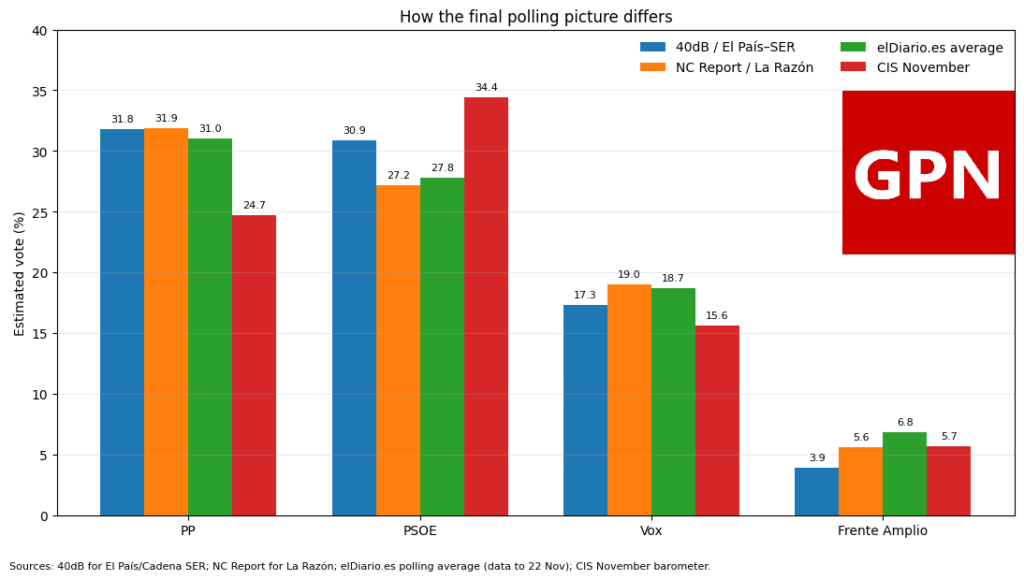
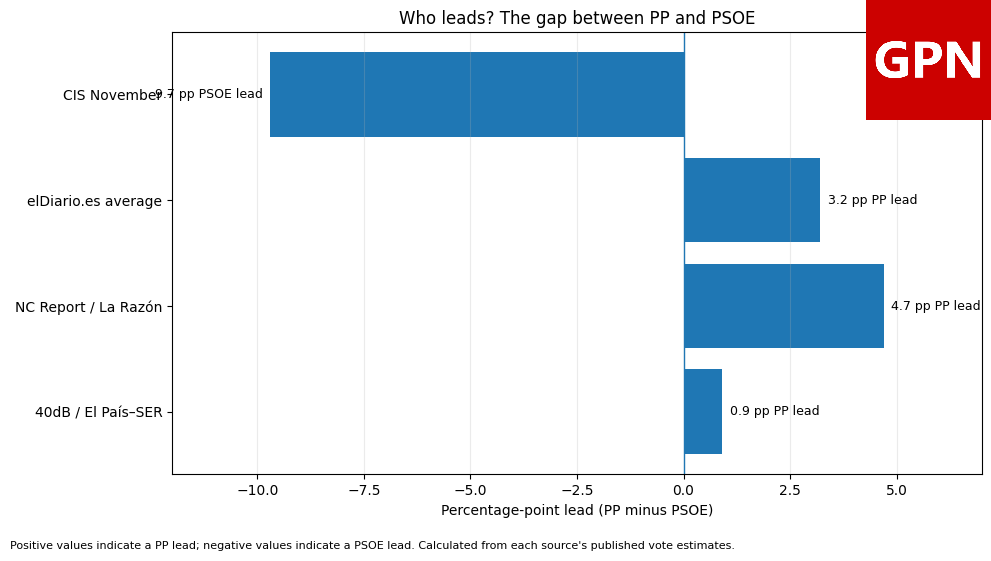
The closest contest comes from 40dB, whose final survey for El País and Cadena SER puts the PP just 0.9 percentage points ahead of the PSOE. Its research combines 7,500 interviews conducted between 10 and 21 November, including a daily campaign tracking exercise.
NC Report’s survey for La Razón, conducted between 16 and 20 November, gives the PP a wider lead of 4.7 points. The elDiario.es average, based on surveys published up to 22 November, places the difference at 3.2 points.
The CIS is the clear exception. Its November barometer, based on 8,034 interviews conducted between 10 and 17 November, estimates PSOE support at 34.4%, against 24.7% for the PP. That is a Socialist lead of 9.7 points.
The gap between PP and PSOE tells two different stories
The comparison shows why it would be misleading to describe the final polling picture as a single, settled forecast.
In the 40dB survey, the two main parties are almost level. NC Report gives the PP a more comfortable advantage, while the elDiario.es average falls between the two. The CIS points in the opposite direction, with Sánchez’s party well ahead.
There are also differences in the position of the smaller parties. Vox is strongest in the NC Report estimate, at 19%, while the elDiario.es average gives Frente Amplio its highest figure among the four sources, at 6.8%. The 40dB estimate is notably lower for Frente Amplio, at 3.9%.
These figures should not be treated as directly interchangeable. The surveys were conducted over different periods and use different sampling and estimation methods. The elDiario.es figure is a weighted polling average, while the CIS applies its own scenario-based estimation model. The comparison is useful for identifying the range of possible outcomes, not for creating the illusion that every source measures voters in exactly the same way.
The parliamentary picture is more consistent
The most important question is not necessarily which party finishes first, but which combination of parties can command a majority in Congress.
Spain’s Congress has 350 seats, making 176 the threshold for an absolute majority. Unlike national vote share, the distribution of seats depends on results in individual provinces, where the number of available representatives and the D’Hondt allocation system can produce very different outcomes.
Here, the available projections are more consistent than the vote estimates.
40dB projects 187 seats for the combined right-wing bloc of PP, Vox and UPN. Its estimate gives the PP 129 MPs, the PSOE 124 and Vox 55. The forces potentially supporting another Sánchez investiture would be left with 158 seats, according to the survey’s projection.
NC Report gives PP and Vox between 194 and 199 seats. That is a comfortable majority, even at the lower end of its range.
The elDiario.es model also puts the right-wing bloc above the threshold, at around 192–193 seats. Its central estimate gives the PP 128 MPs and Vox 65. The model is based on 10,000 simulations using its polling average and estimates the probability of different parliamentary outcomes.
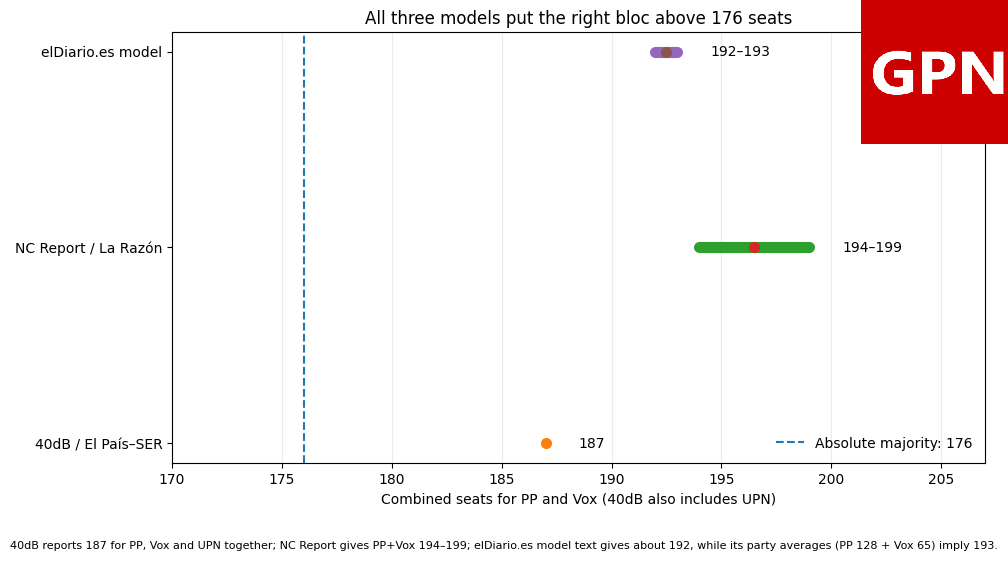
The CIS November barometer does not include a new seat projection, so its vote estimates cannot be compared with these parliamentary forecasts on a like-for-like basis.
The distinction matters. A national lead for one party does not automatically translate into the ability to form a government. The distribution of votes across constituencies, the performance of smaller parties and the agreements available after the election will all shape the final parliamentary balance.
Why does the CIS look so different?
The gap between the CIS and the private estimates is the most striking feature of the final polling picture.
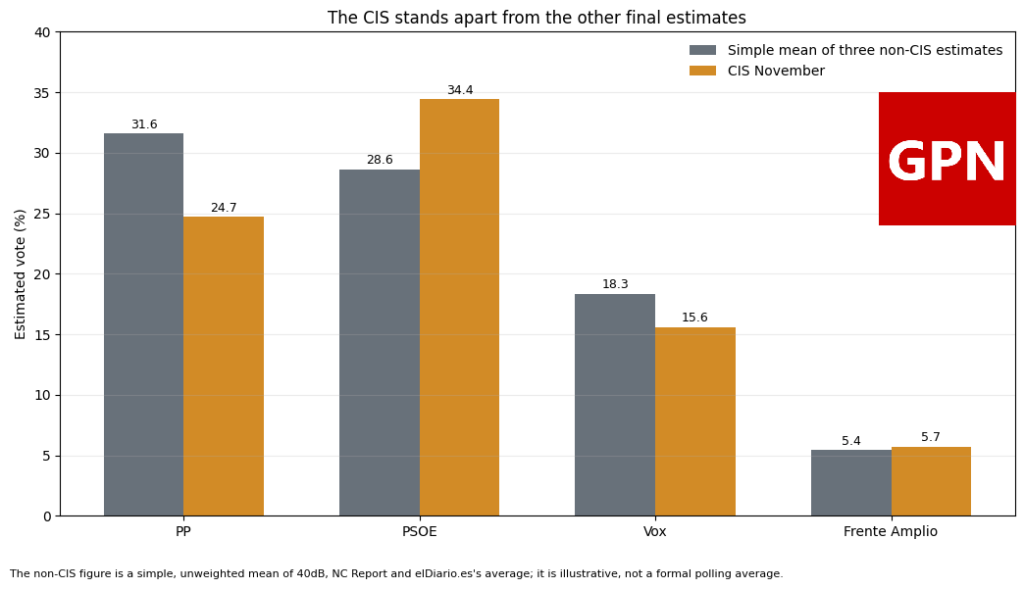
A simple, unweighted average of the three non-CIS estimates included here gives the PP approximately 31.6%, the PSOE 28.6%, Vox 18.3% and Frente Amplio 5.4%. This is an illustrative comparison, not a formal polling average, but it helps show the scale of the difference.
Against that reference, the CIS places the PSOE almost six points higher and the PP nearly seven points lower. It also estimates Vox support at a lower level than the other three sources.
Part of the explanation lies in methodology. The CIS uses the Alaminos-Tezanos two-dimensional inertia-uncertainty model, which estimates electoral support through different scenarios. The institution explicitly describes the result as a measurement related to the period when the interviews were collected, rather than a prospective prediction.
The private surveys also differ from one another. They use their own weighting, fieldwork and electoral models, while the elDiario.es average applies a separate methodology to a collection of polls, giving greater weight to more recent research and adjusting for historical differences between polling firms.
None of these approaches guarantees an accurate result. The differences are a reminder that polling estimates are models built from survey responses, not a count of votes already cast.


What has changed during the campaign?
The latest surveys suggest that the PSOE has recovered some ground, although the scale of that improvement varies.
NC Report records a rise in Socialist support from 26.1% to 27.2% in one week, while the PP falls slightly from 32.1% to 31.9%. Vox remains at 19%. The gap between the two main parties narrows, but the projected majority for PP and Vox remains intact.
The 40dB survey also describes a tightening contest. Its final estimate places Sánchez close to Feijóo, while Vox remains a major force in the projected Congress. The survey suggests that some voters who previously supported Sumar are now moving towards the PSOE, contributing to the Socialist recovery.
The elDiario.es average similarly shows the PSOE gaining ground in recent weeks, but its model still gives PP and Vox a clear parliamentary advantage.
The broader trend is therefore not necessarily a dramatic late reversal. It is a closer contest between the two largest parties, alongside a continuing possibility of a right-wing majority.
The final word before the polling blackout
Monday 23 November is the last day on which electoral polls can legally be published before Spain’s five-day blackout, which runs from 24 to 28 November under Article 69.7 of the electoral law.
The final surveys leave three main conclusions.
First, the PP leads the private estimates considered here, although its advantage over the PSOE ranges from less than one point to nearly five. Second, the CIS offers a sharply different picture, giving Sánchez’s party a substantial lead. Third, despite those differences, the available parliamentary models from 40dB, NC Report and elDiario.es all place the PP–Vox bloc above the 176-seat threshold.
That does not make the election a foregone conclusion. Polling models can be wrong, seat projections depend on how votes are distributed across provinces, and the final result will depend on turnout and the performance of smaller parties.
But as Spain enters the final days before voting, the central question is becoming clearer: can the PSOE turn its late recovery into a challenge to the right-wing parliamentary majority, or will the PP and Vox have enough seats to shape the next government?
The polls have now had their final word. The voters will have theirs on 29 November.