A New York Times investigation has intensified the ongoing Eurovision voting controversy, raising fresh questions about the integrity of the Eurovision televote results 2025, particularly in Spain. The report focuses on an unusually strong public vote for Israel and suggests that the outcome may have been influenced by coordinated voting behaviour, reigniting debate over transparency and fairness in the contest’s global voting system.
The European Broadcasting Union (EBU), which organises Eurovision, has strongly rejected the allegations, defending the Eurovision voting system as secure, transparent, and reliable. Officials dismissed the investigation as speculative and based on assumptions rather than verifiable evidence.
The dispute arrives as Eurovision 2026 begins its rollout, with growing scrutiny over digital campaigning, audience mobilisation, and the long-term credibility of mass public voting systems.
Eurovision 2025 Spain Televote: Key Voting Figures Explained
To better understand the Eurovision televote results in Spain (2025), the data from the New York Times investigation based on RTVE figures can be broken down into clear, comparable statistics.
📊 Spain Televote Breakdown (Top Entries)
Country | Share of Spanish Televote | Estimated Votes |
Israel | 33.34% | ~47,570 votes |
Ukraine | 6.74% | ~9,620 votes |
📌 What the Numbers Show
- Israel led the Spanish public vote by a wide margin, receiving roughly five times more votes than Ukraine.
- The gap appears decisive at first glance, suggesting strong audience preference.
- However, the structure of the Eurovision voting system adds important context.
How Eurovision Voting Rules Impact Results
🔁 Voting System Feature (2025 Rules)
- Each viewer could vote up to 20 times per device
- Votes could be concentrated from the same users
- This increases the impact of high-frequency voting behaviour
🔢 “What If” Scenario: Minimum Voter Impact
The New York Times analysis models how many individuals could theoretically generate the result:
📉 Israel’s Total Votes (~47,570)
- If each person voted 20 times:
- 👉 Only ~2,379 people would be needed
🏁 To surpass Ukraine (~9,620 votes)
- If each person voted 20 times:
- 👉 Fewer than ~500 highly active voters could have been enough
⚠️ Why This Matters
These calculations have raised questions about the structure of the Eurovision public televote, particularly:
- Whether small, highly organised groups can significantly influence outcomes
- How repeat voting rules affect overall fairness perception
- Whether the system reflects broad audience preference or concentrated voting activity
📊 Key Takeaway
While Israel’s result in Spain’s Eurovision 2025 televote appears dominant, the voting structure means that:
A relatively small number of highly active voters could potentially have a disproportionate impact on the final outcome.
Eurovision Televote Results 2025 Raise Questions in Spain
The New York Times investigation focused on Spain’s Eurovision televoting results 2025 Grand Final, where Israel’s entry, Yuval Raphael, reportedly secured an unusually high share of the public vote.
According to the report, based on RTVE’s published data and vote percentage breakdowns, Israel received approximately 33.34% of the Spanish televote, equal to around 47,570 votes.
Ukraine, which finished second in Spain’s public vote, received approximately 6.74%, or about 9,620 votes.
While the result appears decisive, the investigation highlights a structural feature of the Eurovision voting system: viewers can vote multiple times per device, a rule that remained in place during the 2025 contest.
Using this system, the report suggests that a relatively small number of highly active voters could have generated the outcome. It estimates that around 2,379 individuals voting 20 times could account for Israel’s total votes in Spain. Fewer than 500 highly active voters may have been enough to surpass competing entries.
These figures have raised broader concerns about whether Eurovision’s public vote is vulnerable to organised voting campaigns.
Eurovision Voting System Under Scrutiny Amid Manipulation Claims
The investigation claims that Spain may not be an isolated case. Similar voting patterns reportedly appeared in other countries where public polling indicated critical views of Israeli government policies, yet Israel still performed strongly in the Eurovision public vote.
The report suggests this may point to coordinated digital mobilisation campaigns, although it does not provide direct evidence of organised manipulation.
A central concern is structural: the combination of high-volume voting allowances and modern social media campaigning, which can amplify the influence of small but highly organised groups.
The New York Times also highlights a lack of full transparency in Eurovision voting datasets, limiting independent auditing and external verification of results.
EBU Rejects Eurovision Voting Manipulation Allegations
The EBU has strongly defended the Eurovision voting system, rejecting claims of irregularities in the televoting results 2025.
Speaking in Vienna, Eurovision director Martin Green dismissed the report’s methodology.
He also described the investigation as a “rehash” focused on outcomes rather than evidence of manipulation.
Green insisted that Eurovision is designed to reflect musical preference, not political sentiment.
Despite growing criticism, the EBU maintains that no evidence of systemic manipulation has been found.
Promotion Campaigns and Eurovision Voting Rule Changes
Concerns over promotional activity have further fuelled the Eurovision voting controversy.
The EBU confirmed that organisers intervened during the 2025 contest after identifying promotional content encouraging repeated voting for specific entries. In one case, officials contacted the Israeli delegation after videos urged audiences to vote multiple times per device.
The content was reportedly removed following EBU intervention.
The incident contributed to pressure from broadcasters such as RTVE, which called for an independent Eurovision voting audit and greater transparency in vote reporting.
However, the EBU did not commission a full external review, opting instead for internal assessments and targeted rule adjustments.
Broadcaster Tensions and Eurovision Boycott Threats
By late 2025, tensions between participating broadcasters had escalated. Several countries—including Spain, Iceland, Ireland, Slovenia, and the Netherlands—raised concerns over both participation rules and voting transparency.
Some broadcasters even discussed a possible Eurovision boycott.
Rather than hold a direct vote on participation, the EBU introduced rule changes during its General Assembly. These included reducing the maximum number of votes per viewer from 20 to 10 and tightening restrictions on promotional campaigns considered disproportionate.
The EBU argued the reforms would improve fairness while avoiding politicisation of participation decisions. Critics, however, said the approach avoided direct accountability on sensitive issues.
Five broadcasters have confirmed they will not participate in the 2026 edition.
Eurovision 2026 Voting Changes: Will They Be Enough?
The updated Eurovision voting rules 2026 aim to reduce the impact of mass voting campaigns by limiting each viewer to 10 votes.
The New York Times analysis suggests the change may reduce—but not eliminate—the influence of coordinated voting groups. It estimates Israel would still have needed fewer than 1,000 highly active voters in Spain to replicate a similar outcome.
The EBU maintains that the new system significantly strengthens safeguards against manipulation while preserving audience participation.
However, critics argue that the core issue remains unresolved: limited transparency in voting data and difficulty distinguishing organic support from organised campaigns.
Eurovision Voting Integrity Debate Continues
At the centre of the debate is a broader question about the future of large-scale public voting systems in the digital age.
Eurovision has long combined jury votes with public televoting to balance artistic merit and audience preference. However, the rise of social media campaigning and repeat voting has introduced new challenges for regulators.
The New York Times report does not claim proven wrongdoing, but highlights structural vulnerabilities that could allow small groups of voters to influence outcomes disproportionately.
For the EBU, the challenge is maintaining trust in a system built on mass participation. For critics, the issue is whether the Eurovision televote system can still reliably reflect genuine public sentiment.
Eurovision 2026: A Controversy That Remains Unresolved
As Eurovision 2026 unfolds in Vienna, debate over voting integrity shows no sign of fading. With several countries absent and scrutiny increasing, the contest continues to balance entertainment, politics, and institutional credibility.
The EBU insists its voting system is fair, secure, and robust. Yet the questions raised by the New York Times investigation ensure that the Eurovision voting controversy remains unresolved heading into the new season.
Information Source:
https://www.nytimes.com/2026/05/
Photo Attribution:
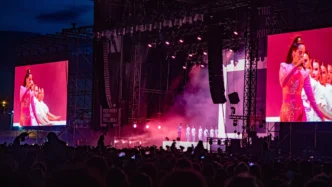
Eurovision 2023 – Stage, by Michael Doherty Creative Commons Attribution-Share Alike 4.0 International license Wikimedia Commons: https://w.wiki/NFAS
English
Español