

 English
 Español

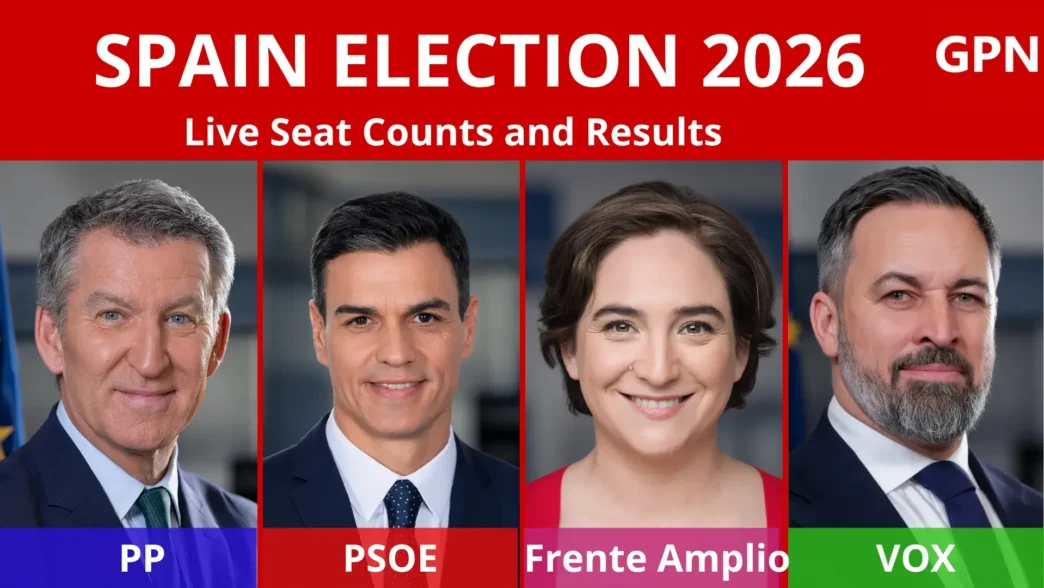
By GPN Newsroom · Edited by Ivan R. Montes, Editor-in-Chief · Published 27 November 2026 · Last updated: [27/11/2026, 11:40 CET] · Type: Live
Status: pre-election guide. Live coverage starts on Sunday 29 November at 09:00 CET (08:00 GMT). Until then this page explains what is at stake. From the close of polls it becomes our live results page and the tables below will be updated through the night. Bookmark this URL: it will not change.
| Time (CET / GMT) | Update |
|---|---|
| 27 Nov, [11:40] CET | Page published. Live coverage starts on Sunday 29 November at 09:00 CET. |
All times in CET (GMT is one hour earlier).
Live results: Congress of Deputies seat count
A party needs 176 of the 350 seats for a majority. The count comes from the Interior Ministry’s provisional results. Seats shown for a partial count are what the votes counted so far would produce; they are not a projection.
Votes counted: —% • Last updated: [time] CET
| Party | 2023 seats | Seats won or ahead | Vote share (%) |
|---|---|---|---|
| PPAlberto Núñez Feijóo | 137 | — | — |
| PSOEPedro Sánchez | 121 | — | — |
| VoxSantiago Abascal | 33 | — | — |
| Frente Amplio (Sumar in 2023)Ada Colau | 31* | — | — |
| PodemosIrene Montero | See note | — | — |
| ERC | 7 | — | — |
| Junts | 7 | — | — |
| EH Bildu | 6 | — | — |
| PNV | 5 | — | — |
| Others (BNG, CC, UPN) | 3 | — | — |
*Sumar’s 31 seats in 2023 included candidates from Podemos, which now runs separately. Seats shown for a partial count are what the votes counted so far would produce; they are not a projection. Source: Spain’s Interior Ministry (provisional count).
Where the blocs stand
| Bloc | Parties | Recent public projections | Seats now |
|---|---|---|---|
| Right | PP + Vox | About 186–194 | — |
| Left | PSOE + Frente Amplio + Podemos | About 129 | — |
| Sánchez’s 2023 partners | Left bloc plus the regional parties that backed his last investiture | About 158 | — |
Projections are not results.
Turnout
| Moment | 2026 turnout | Note |
|---|---|---|
| 14:30 CET | — | First Interior Ministry update |
| 18:30 CET | — | Second Interior Ministry update |
| Final | — | 2023 final turnout: 66.6% |
Turnout figures are the Interior Ministry’s provisional data.
What the final polls projected and what the exit polls say
| Party | Recent public projections | Exit poll |
|---|---|---|
| PP | 123–136 | — |
| PSOE | 116–127 | — |
| Vox | 51–68 | — |
| Frente Amplio | 8–12 | — |
| Podemos | 0–2 | — |
| ERC, Junts, EH Bildu, PNV and others | Not projected here | — |
Projection ranges combine published estimates from 40dB, RTVE’s polling average, poll.graphics, Demócrata and others. Projections are not results. Exit polls are estimates published when polling stations close.
Election night timeline (CET; GMT is one hour earlier)
Times are based on past practice and may change. We will confirm them on the day against the Interior Ministry’s official election site, 29neleccionesgenerales.es.
- 09:00 (08:00 GMT): polling stations open.
- 14:30 and 18:30: the Interior Ministry normally publishes turnout figures.
- 20:00 (19:00 GMT): polling stations close on the mainland. TV channels normally publish exit polls at this point. They are estimates, not results.
- 20:00 Canary Islands time (21:00 CET): polls close in the Canaries, where local time is an hour behind the mainland. In 2023 the Interior Ministry began publishing its first official figures at 21:00, once every polling station had closed.
- Before midnight: most of the provisional count is usually in.
- Following days: the official general count by the electoral boards, which can change close seats.
- By 24 December: the new Cortes must meet, within 25 days of the vote.
What to watch tonight
- Can the PP and Vox reach 176? The final public polls pointed that way. In the poll-of-polls model by Demócrata, the two parties reached a majority in 94.8% of simulations, with a central range of 179 to 199 seats. That is a model, not a result: in 2023 the PP won but with less support than expected and Feijóo fell short of a majority.
- How big is Vox’s surge? Vox won 33 seats in 2023. Final projections range from the low 50s to the high 60s. Feijóo says he wants a majority backed by parliamentary support agreements with Vox, and says Abascal has never discussed ministries with him.
- Does the PSOE close the gap? The last 40dB poll for El País and Cadena SER had the PP at 31.8% and the PSOE at 30.9%. RTVE’s final polling average was wider: 31% against 28.7%.
- How much does the left lose from its split? Frente Amplio, a new coalition fronted by Ada Colau that has largely replaced Sumar, runs against Podemos, which Irene Montero leads separately. Projections put Frente Amplio far below Sumar’s 31 seats in 2023.
- Who holds the regional keys? Junts, ERC, PNV, EH Bildu, BNG and Coalición Canaria may matter if neither bloc reaches 176. Junts voted with the PP and Vox against the first of the two housing decrees that triggered this election.
- Navarra: the PP and UPN run a joint list this time, which affects how PP seat numbers compare with 2023.
- Turnout: 66.6% in 2023. Analysts have pointed to demobilisation on the left as a risk for Frente Amplio.
Provinces to watch
Seats are decided province by province, so national vote shares can mislead. We track eight districts that together elect 135 of the 350 seats (2023 allocation): Madrid, Barcelona, Valencia, Alicante, Seville, Málaga, Murcia and Navarre. The first table shows what happened there in 2023; the second is our live tracker for election night.
What happened in 2023
| Province | Seats | First | Second | Gap (pp) | Vox | Sumar | What to watch |
|---|---|---|---|---|---|---|---|
| Madrid | 37 | PP 40.5% (16 seats) | PSOE 27.8% (10) | 12.7 | 14.0% (5) | 15.5% (6) | The largest district: a swing here moves many seats at once. |
| Barcelona | 32 | PSC-PSOE 35.7% (13) | Sumar 15.2% (5) | 20.5 | 7.6% (2) | 15.2% (5) | PP 13.8% (5), ERC 12.3% (4) and Junts 9.7% (3): the Catalan seats matter for the blocs. |
| Valencia | 16 | PP 33.6% (6) | PSOE 32.1% (5) | 1.5 | 15.2% (2) | 16.9% (3) | The closest of these eight in 2023. |
| Alicante | 12 | PP 36.7% (5) | PSOE 32.0% (4) | 4.7 | 16.3% (2) | 12.9% (1) | One seat separated PP and PSOE. |
| Seville | 12 | PSOE 36.6% (5) | PP 33.4% (4) | 3.2 | 13.3% (1) | 14.0% (2) | One of three of these eight where the PSOE finished first. |
| Málaga | 11 | PP 38.3% (5) | PSOE 30.3% (3) | 8.0 | 16.5% (2) | 12.3% (1) | Vox won two seats. |
| Murcia | 10 | PP 41.2% (4) | PSOE 25.3% (3) | 15.9 | 21.8% (2) | 9.6% (1) | Highest Vox share of these eight. |
| Navarre | 5 | PSN-PSOE 27.4% (2) | EH Bildu 17.2% (1) | 10.1 | 5.7% (0) | 12.8% (0) | PP 16.7% (1) and UPN 15.3% (1) ran separately in 2023; combined 32.0%. In 2026 they run a joint list, so compare with care. |
Gap = difference between the first and second parties in votes, in percentage points. Seats are the 2023 allocation. Source: Interior Ministry results for the 23 July 2023 general election. A party’s share can rise while its seats fall, because seats are decided province by province.
Live tracker
| Province | Seats | 2023 winner | % counted | Leading now | Change vs 2023 | Seats now (PP / PSOE / Vox / others) |
|---|---|---|---|---|---|---|
| Madrid | 37 | PP | — | — | — | — |
| Barcelona | 32 | PSC-PSOE | — | — | — | — |
| Valencia | 16 | PP | — | — | — | — |
| Alicante | 12 | PP | — | — | — | — |
| Seville | 12 | PSOE | — | — | — | — |
| Málaga | 11 | PP | — | — | — | — |
| Murcia | 10 | PP | — | — | — | — |
| Navarre | 5 | PSN-PSOE | — | — | — | — |
Last updated: [time] CET. “Change vs 2023” compares with the 2023 result in the same province; in Navarre, compare with the combined PP and UPN vote.
How we will cover the count
- Official figures come from the Interior Ministry’s provisional count. We label exit polls and do not mix them with results.
- We do not call winners from partial counts.
- Every update in the log below is time-stamped in CET and GMT.
- If we get something wrong we correct it in the page and note it.
Why Spain is voting now
On 2 October the Congress voted down two emergency housing decrees, including one that would have let tenants renew their leases automatically, as protests over rents and evictions grew. Junts, one of Pedro Sánchez’s 2023 allies, voted against the first decree alongside the PP and Vox. Three days later, on 5 October, Sánchez announced the dissolution of the Cortes and called the election for Sunday 29 November. The decree appeared in the BOE on 6 October.
The campaign ran from 13 to 27 November. Saturday 28 November is the ‘day of reflection’, when campaigning is not allowed. Polls may not be published in the five days before the vote, so the last public polls date from 23 November.
Housing is the leading public concern: almost 56% named it among the country’s three main problems in an October CIS survey. Immigration, the cost of living and corruption have also dominated the campaign.
The contenders and what they offer
- PP (Alberto Núñez Feijóo): promises to secure Spain’s borders and require newcomers to integrate, and proposes repealing the Housing Law and eliminating stressed rental areas and the rental price index.
- PSOE (Pedro Sánchez): asks voters to defend his government’s social gains and proposes temporarily freezing certain rents.
- Vox (Santiago Abascal): campaigns for tighter immigration controls and ‘national priority’ for Spanish citizens in welfare and subsidies, and wants to repeal the Housing Law. Feijóo has said the national priority policy would run counter to Spain’s constitution and EU treaties.
- Frente Amplio (Ada Colau): puts housing, taxes on the wealthiest and pensions up front, with rent caps and indefinite lease contracts.
- Podemos (Irene Montero): rejected the new alliance and runs separately in most constituencies.
What the final polls said (and why to be careful)
| Source | PP | PSOE | Vox | Note |
|---|---|---|---|---|
| 40dB for El País and Cadena SER (10–21 Nov, 7,500 interviews) | 31.8% (127–136 seats) | 30.9% (116–127) | 17.3% (51–61) | Final poll in the series |
| RTVE final polling average | 31% (128 seats, including UPN) | 28.7% (116) | — | Average of published polls |
| poll.graphics nowcast (22 Nov) | 123 seats | 117 | 63 | Frente Amplio 11 |
| Demócrata poll of polls | 128 seats | 116 | 63 | PP plus Vox 191 |
Polls differ by pollster and method, and seat projections depend on how votes fall province by province. Treat all of these as estimates. Polls may not be published in the five days before the vote, so the last public polls date from 23 November.
Explained: how Spain’s electoral system works
- 350 seats in the Congress of Deputies are elected in 52 constituencies (the 50 provinces plus Ceuta and Melilla). A party’s lead in one province decides only that province’s seats.
- Seats are allocated by the D’Hondt method, which tends to favour larger parties in smaller provinces. Parties generally need at least 3% of the valid votes in a constituency to win seats there.
- 176 seats make a majority. Both the Congress and the Senate are elected on the same day; Senate seats follow a different rule.
From vote to government: what happens next
After the election the King proposes a candidate for prime minister. In the first investiture vote the candidate needs an absolute majority (176). If that fails, a second vote about 48 hours later needs more yes votes than no votes. In 2023 Sánchez was re-elected after a deal with Junts. The new Cortes must meet within 25 days of the vote, by 24 December.
What it means for foreign residents
Most foreign residents cannot vote on Sunday. EU citizens registered in Spain can vote in municipal and European elections but not in general elections.
The result still shapes rules that affect people living in Spain. On housing, the PSOE and Frente Amplio propose limits on rents in stressed areas, while the PP and Vox want to repeal the Housing Law and use tax incentives to encourage more stable rental contracts. On immigration, the PP wants controlled immigration and integration requirements, while Vox wants tighter controls and national priority rules for welfare. After the results we will update this section with what the new arithmetic could mean for rental rules, residency and taxes.
Where the parties stand
Housing
- PP: repeal the Housing Law and end stressed rental areas and the rental price index; one million homes.
- PSOE: temporary freeze on certain rents; 100,000 public homes.
- Vox: repeal the Housing Law; evictions in 24 hours; national priority for public housing.
- Frente Amplio: 1.5 million public homes and rent caps.
- Podemos: rents cut by 40%; ban on buying homes to speculate.
Residency and migration
- PP: a single migration authority with annual caps by sector; faster returns of irregular arrivals.
- PSOE: [verify in the manifesto]
- Vox: deportations and repatriations; national priority in benefits.
- Frente Amplio: complete the 2026 extraordinary regularisation; a permanent regularisation procedure; close the CIE detention centres.
- Podemos: [verify in the manifesto]
Summaries based on press coverage of each manifesto; check the manifesto pages. If a manifesto says nothing on a topic, we say so.
Read the manifestos
Read the manifestos
- PP: ‘Reconstrucción Nacional’, 249 measures, 82 pages. Full text via Artículo 14 or Demócrata.
- PSOE: electoral programme. Full text via Última Hora; summary via Artículo 14.
- Vox: ‘Es sentido común’, 115 measures. PDF hosted by El Independiente or Demócrata.
- Frente Amplio: programme with more than 1,000 measures. Official programme page; summary via Artículo 14.
- Podemos: electoral programme via Demócrata or Público.
- Compare four programmes: Demócrata’s manifesto comparator.
Links go to the media outlets that host or summarise each document; we replace them with the parties’ own PDFs where available. Documents are in Spanish.
Spanish election terms in plain English
- Escrutinio provisional: the quick count published on election night. Escrutinio general: the official count by the electoral boards in the following days.
- Escaño: a seat in the Congress. Mayoría absoluta: 176 seats.
- Investidura: the vote in Congress to confirm a prime minister.
- Jornada de reflexión: the day before the vote, when campaigning is banned.
- Cortes Generales: Spain’s parliament, made up of the Congress of Deputies and the Senate.
- Frente Amplio: the new left coalition that has largely replaced Sumar.
Frequently asked questions
When is Spain’s 2026 general election?
Sunday 29 November 2026. Polling stations are open from 09:00 to 20:00 local time.
What time will the results come out?
Exit polls are expected at 20:00 CET (19:00 GMT). The Interior Ministry’s first official figures are expected from around 21:00 CET, after the Canary Islands close, and most of the provisional count is usually in before midnight.
How many seats does a party need to govern?
176 of the 350 seats in the Congress of Deputies for an outright majority. Without one, parties must negotiate support in the investiture vote.
When will Spain’s new government be formed?
The new Cortes must meet within 25 days, by 24 December. A government is not formed on election night: the King proposes a candidate and an investiture vote follows.
Can foreigners vote in Spain’s general election?
No. Foreign residents, including EU citizens, cannot vote in general elections.
Sources
By GPN Newsroom · Edited by Ivan R. Montes, Editor-in-Chief · Read how we work.
- La Moncloa – Official announcement of the 2026 general election (5 October 2026)
- Spanish Ministry of the Interior – Official 2026 general election information
- Spanish Ministry of the Interior – 2023 election-night results coverage and arrangements
- idealista/news – What foreign residents need to know about Spain’s 2026 general election
- Bloomberg – 40dB poll for El País: Spain’s latest electoral projections
- Spain in English – Final polls ahead of Spain’s 2026 general election
- poll.graphics – Final projection for Spain’s 2026 general election
- Demócrata – Poll of polls: final survey of Spain’s 2026 election
- Convergent Opinion – MRP electoral model for Spain
- The Olive Press – Political debate and election polling round-up
- Anadolu Agency – Spain launches its election campaign ahead of the 29 November vote
- Demócrata – PSOE, PP, Vox and Frente Amplio housing and rental proposals
- 2023 Spanish general election – Results and background