

 English
 Español


Spanish Prime Minister Pedro Sánchez has announced a new national system designed to measure and combat hate speech on social media.
The tool, called HODIO — Huella del Odio y la Polarización (Footprint of Hate and Polarization), will track the spread of online hate speech and political polarization across major social media platforms used in Spain.
The system will also produce a public ranking of tech platforms based on how much harmful or hateful content circulates on them, increasing pressure on companies to improve moderation.
The initiative was unveiled during Spain’s first Forum Against Hate, part of a broader government strategy to tackle online disinformation, digital hostility, and growing political polarization on social media.

How Spain’s HODIO System Will Track Hate Speech Online
The HODIO monitoring system will be operated by the Spanish Observatory of Racism and Xenophobia (Oberaxe), part of Spain’s Ministry of Inclusion, Social Security and Migration.
The platform will analyze how hate speech spreads across social media networks, including:
- TikTok
- X (formerly Twitter)
- YouTube
Using artificial intelligence combined with expert human analysis, the system will measure:
- The prevalence of hate speech
- The reach of harmful posts
- The amplification of hate through algorithms
The results will be published in a transparent ranking showing which social media platforms expose users to the most hate speech and polarizing content.
Sánchez compared the concept to a carbon footprint, arguing that transparency can create accountability.
“The objective is to bring hate out of the shadows, make it visible, and demand responsibility from those who fail to act.”

Rising Concern About Online Polarization
The Spanish government has increasingly warned about the growing influence of social media on political debate and public opinion, particularly among younger users.
According to government data:
- Three out of four young people in Spain encounter hate speech online
- Analysts detect around 1,300 hateful messages every day
- Hate crimes have increased by 41% in the past decade
Sánchez argues that online hate is often deliberately amplified, turning social media into a political battleground.
“Hate is manufactured. It has become a political weapon,” he said.
“For some actors, it is their main electoral asset.”
The prime minister also criticized social media algorithms that promote controversial content because it drives engagement and advertising revenue.
“Technology is power; it is politics,” Sánchez said.

Spain Pressures Tech Companies Over Hate Speech
According to figures cited by the Spanish government, hate speech on the platform increased by around 50% after the acquisition.
The Spanish government now wants technology companies to take greater responsibility for harmful content, including how algorithms amplify controversial posts.
Officials are even considering a new legal concept called “algorithmic amplification crime.”
Under this idea, developers of recommendation algorithms could be held accountable if their systems promote hate speech or extremist content.
“Those who design algorithms that amplify hatred must assume responsibility,” Sánchez said.

Existing Tools Monitoring Hate Speech in Spain
The HODIO system builds on several tools already used by the Spanish government to monitor online hate.
The Spanish Observatory of Racism and Xenophobia began tracking hate speech on social media in 2020, during the COVID-19 pandemic.
In 2022, the observatory launched Alertodio, a monitoring platform developed with the Universitat Politècnica de València.
In 2024, Spain partnered with the football league LaLiga to launch FARO, an AI system that detects abusive and hateful language on social media platforms.
These tools have already revealed dramatic spikes in hate speech during political crises.
For example, during unrest in the town of Torre Pacheco in 2024, analysts detected:
- 33,000 hate-filled social media comments
- compared with the normal daily average of around 2,000
That represents a 1,500% increase in online hate speech.
What the HODIO System Will Add
While existing systems mainly detect hate speech posts, the HODIO system will analyze the broader impact of online hate.
The platform will measure:
- How common hate speech is on each social network
- How algorithms amplify harmful content
- The overall reach and influence of online polarization
By publishing a public ranking of social media platforms, the Spanish government hopes to increase accountability and encourage stronger moderation policies.
The system is still under development, but officials say it will soon provide regular reports on Spain’s digital information environment.
For Sánchez, the goal is clear.
Frequently Asked Questions About Spain’s HODIO System
What is the HODIO system?
The HODIO system (Huella del Odio y la Polarización) is a monitoring tool launched by the Spanish government to track hate speech and political polarization on social media platforms.
The system will analyze how hateful or harmful content spreads online and publish public rankings of major platforms based on the amount of problematic content they host.
Its goal is to increase transparency and accountability among tech companies operating in Spain.
How does the HODIO system track hate speech on social media?
The HODIO system uses artificial intelligence combined with expert human analysis to monitor posts on popular platforms such as:
- TikTok
- X (formerly Twitter)
- YouTube
The platform evaluates several indicators, including:
- how often hate speech appears
- how widely it spreads
- how algorithms amplify harmful content
The data will then be used to produce a public ranking comparing exposure to hate speech across social media platforms.
Why did Spain create the HODIO system?
Spain introduced the HODIO system as part of a broader effort to combat online hate speech, disinformation, and digital polarization.
According to government data, three out of four young people in Spain encounter hate speech online, while analysts detect around 1,300 hateful messages every day on social media.
Officials say the new system aims to:
- make hate speech more visible
- encourage stronger moderation by tech companies
- increase accountability for algorithms that amplify harmful content
The initiative is also intended to help policymakers better understand how online discourse influences real-world tensions and hate crimes.
Information Source:
Photo Attribution:
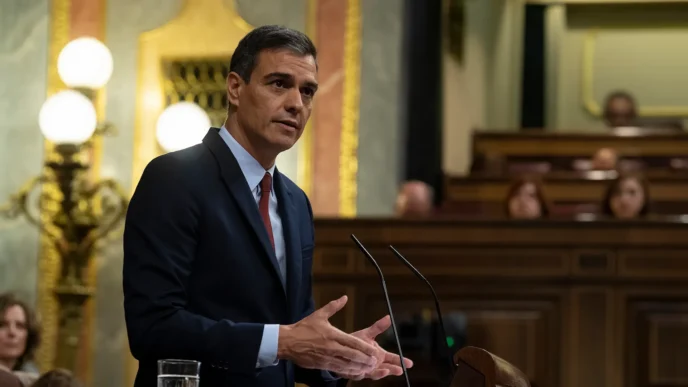
Photo: Pedro Sánchez and Begoña Gómez at Number 10 for NATO leaders meeting (3 Dec 2019) by Ministry of the Presidency, Government of Spain / La Moncloa. Licensed under the Government of Spain’s legal notice (free use with attribution and date, no distortion).
Visita de Pedro Sánchez. Núria Parlon Gil / Flickr / Wikimedia Commons (CC BY 2.0)
Photo credit: Elon Musk and President of Argentina Javier Milei speaking at the 2025 Conservative Political Action Conference (CPAC) at the Gaylord National Resort & Convention Center in National Harbor, Maryland, by Gage Skidmore, used under Creative Commons Attribution-ShareAlike 2.0 Generic (CC BY-SA 2.0). License: https://creativecommons.org/licenses/by-sa/2.0/. Source: Wikimedia Commons: https://w.wiki/Hj5V
A screengrab from an AI-generated video on TikTok. Illustration: TikTok
TikTok flooded with artificially generated videos featuring migrants – Source X